Want to know the 2 biggest barriers to trust?
As Patrick Lencioni says: “Based on my experience working with teams, I’ve come to one inescapable conclusion: no quality or characteristic is more important than trust. Unfortunately there is no quality or characteristic as rare as trust either.”
Nothing is more important than trust.
Nothing is as rare as trust.
Why then is it so hard to navigate as a team?
In my work as a leadership coach with high performing teams, I’ve come to spot two core, fundamental challenges, that time and again undermine trust in teams.
Barrier 1. We assume we all mean the same thing when we say “trust.”
Barrier 2. We treat trust as fixed - something that, once broken, is gone for good.
As a result, when I’m brought in to work with teams on trust, we focus on two things.
Unlock 1: How to define trust and make it TANGIBLE
Unlock 2: How to see trust as MALLEABLE
1.Unlock One: Defining Trust
Trust is one of those ubiquitous words we all use… without ever really defining.
We assume alignment.
But in reality, each of us comes to trust shaped by our own lived experiences.
So a useful place to start is this:
What are the core elements of trust - for YOU?
What matters most to you?
Is it important that people can be relied upon to do what they say they will?
Is it important that someone’s behaviour is consistent and predictable?
Is it important that people operate within what they’re capable of?
Is it important that people's actions align with their values and what they stand for?
Is it important that people put the team before their own self-interest?
Is it important that people can ask for help when they need it?
What feels least important?
Would someone who works closely with you, be able to predict this? Who do you know that demonstrates these qualities well?
There are many theories of what constitutes trust.
I studied the work of Patrick Lencioni, Brene Brown, Rachel Botsman and Eric Blondeau to distill 6 core elements that came up time and time again in the research.

Reliability
Consistency
Competence
Integrity
“Bigger than me”
Vulnerability
There’s not a right or wrong approach.
We each prioritise different elements - what’s important is that you have an awareness of where you place them - and where those around you place them.
2. Unlock Two: Seeing Trust as Malleable
There’s a belief many people carry: once trust is broken, it’s gone.
That might feel true in some areas of life.
But at work - where you still need to collaborate, deliver, and move forward together - that belief can be incredibly limiting.
I love this quote from Molly Graham:
“Trust is one of the currencies of work. It is exchanged every time we interact with someone. Do I trust this person to execute this project? To lead this initiative? To have my back? Each interaction either adds or detracts from our trust of that person.”
The idea that trust is malleable works really nicely with the Trust Battery analogy from Shopify.
This idea that each relationship we are part of, has a battery that at any given time can be empty, partially or fully charged with levels of trust.
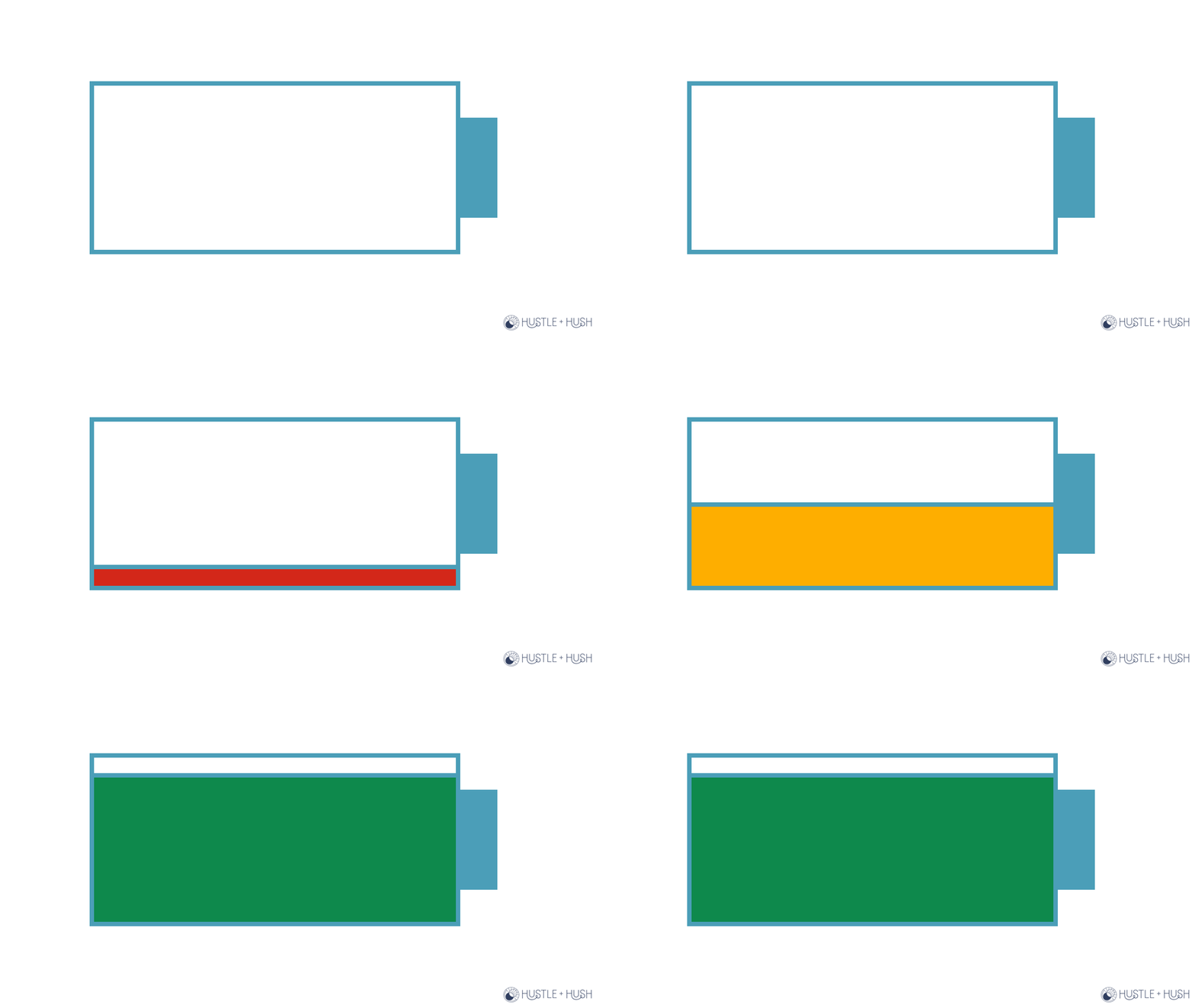
Perhaps ask yourself - how do you feel and act when trust is LOW? What about when it’s HIGH?
And what level of charge do the trust batteries of your key working relationships have? Are they HIGH or LOW right now?
As Brene Brown says, “Trust is not built in the big sweeping moments. It’s built in tiny everyday moments.”
Once you’re clearer on:
what trust looks like for you (and others)
and that trust is something that can be built, repaired, and strengthened
…you have far more agency than you might think.
A simple next step:
What are five small, intentional actions you could take to charge a trust battery this week?
Not grand gestures.
Just consistent, everyday moments.
If you’d like to explore TRUST as a workshop or away day exercise with your high-performing team - please reach out for a chat with our founder, Tee.